(AFP/Reuters)-Sri Lanka’s new leader on Thursday backed a controversial IMF bailout, marking a U-turn from his election pledge to renegotiate the deal secured by his predecessor.
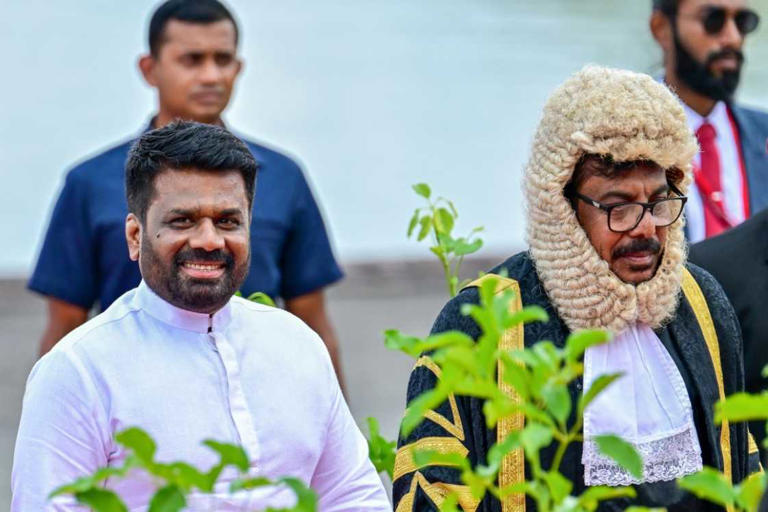
Leftist President Anura Kumara Dissanayake, who tightened his grip on power last week after winning a huge majority in the legislature following his own victory in September, vowed to maintain the IMF programme.
The $2.9 billion loan secured early last year required Colombo to sharply raise taxes, remove generous energy subsidies and agree to restructure more than 50 loss-making state enterprises.
Dissanayake’s National People’s Power party had said it did not agree with the International Monetary Fund’s debt assessment and would renegotiate the bailout programme.
But in his first address to the new parliament, where his party enjoys a two-thirds majority, Dissanayake said the economic recovery was too fragile to take risks.
“The economy is in such a state that it cannot take the slightest shock… there is no room to make mistakes,” he said as he ruled out negotiations with either the IMF or creditors.
“This is not the time to discuss if the terms are good or bad, if the agreement is favourable to us or not… The process had taken about two years and we cannot start all over again,” he said.
The delayed third review of the four-year loan programme could be concluded by this weekend, with the finance ministry holding talks with a visiting IMF delegation in Colombo, he added.
Sri Lanka expects the next tranche of about $330 million following an early approval from the board of the international lender of last resort.
Dissanayake’s interim cabinet last month signed off on a controversial restructuring of $14.7 billion in foreign commercial credit tentatively agreed by predecessor Ranil Wickremesinghe.
The debt restructuring is a key IMF demand to rebuild the island’s economy, which suffered its worst crisis in 2022 when it shrank 7.8 percent.
A delegation from the International Monetary Fund is in Colombo for the third review of its $2.9 billion programme and will hold a press briefing on Saturday.
Dissanayake also outlined plans to complete a $12.5 billion debt restructuring with bondholders in December.
Sri Lanka will enter into individual agreements with bilateral creditors including Japan, China and India needed to complete a $10 billion debt restructuring, he added.
“Our economy is hanging by a thread. This economy cannot absorb any shocks. We have to think deeply and in detail about the policy decisions we take. The moment we obtained power our priority was to build confidence and reassure stakeholders,” he told lawmakers.
“We need to do much more to put the economy on a stable path.”
A nation of 22 million, Sri Lanka was crushed by a 2022 economic crisis triggered by a severe shortage of foreign currency that pushed it into a sovereign default and caused its economy to shrink by 7.3% in 2022 and 2.3% last year.


 MDW Live! News Network
(AFP/Reuters)-Sri Lanka’s new leader on Thursday backed a controversial IMF bailout, marking a U-turn from his election pledge to renegotiate the deal secured by his predecessor.
Leftist President Anura Kumara Dissanayake, who tightened his grip on power last week after winning a huge majority in the legislature following his own victory in September, vowed to maintain the IMF programme.
The $2.9 billion loan secured early last year required Colombo to sharply raise taxes, remove generous energy subsidies and agree to restructure more than 50 loss-making state enterprises.
Dissanayake’s National People’s Power party had said it did not agree with the International Monetary Fund’s debt assessment and would renegotiate the bailout programme.
But in his first address to the new parliament, where his party enjoys a two-thirds majority, Dissanayake said the economic recovery was too fragile to take risks.
“The economy is in such a state that it cannot take the slightest shock… there is no room to make mistakes,” he said as he ruled out negotiations with either the IMF or creditors.
“This is not the time to discuss if the terms are good or bad, if the agreement is favourable to us or not… The process had taken about two years and we cannot start all over again,” he said.
The delayed third review of the four-year loan programme could be concluded by this weekend, with the finance ministry holding talks with a visiting IMF delegation in Colombo, he added.
Sri Lanka expects the next tranche of about $330 million following an early approval from the board of the international lender of last resort.
Dissanayake’s interim cabinet last month signed off on a controversial restructuring of $14.7 billion in foreign commercial credit tentatively agreed by predecessor Ranil Wickremesinghe.
The debt restructuring is a key IMF demand to rebuild the island’s economy, which suffered its worst crisis in 2022 when it shrank 7.8 percent.
A delegation from the International Monetary Fund is in Colombo for the third review of its $2.9 billion programme and will hold a press briefing on Saturday.
Dissanayake also outlined plans to complete a $12.5 billion debt restructuring with bondholders in December.
Sri Lanka will enter into individual agreements with bilateral creditors including Japan, China and India needed to complete a $10 billion debt restructuring, he added.
“Our economy is hanging by a thread. This economy cannot absorb any shocks. We have to think deeply and in detail about the policy decisions we take. The moment we obtained power our priority was to build confidence and reassure stakeholders,” he told lawmakers.
“We need to do much more to put the economy on a stable path.”
A nation of 22 million, Sri Lanka was crushed by a 2022 economic crisis triggered by a severe shortage of foreign currency that pushed it into a sovereign default and caused its economy to shrink by 7.3% in 2022 and 2.3% last year.
Share this: